
Special Interest Conference: Precision Motion Systems & Control
Brabanthallen’s-Hertogenbosch, The Netherlands, NL
17th – 18th November 2026
In conjunction with the Precision Fair, we are delighted to bring together our third Special Interest Conference on Precision Motion Systems & Control.
Precision motion systems and their control are key elements for precision engineering, both for manufacturing applications as well as for measuring instruments. From one-dimensional systems to complex multi-axis machines, components for linear and angular guides, actuation, measurement and control of motion are needed for precision positioning tasks.
Increasing demands on the throughput of manufacturing systems and measuring instruments lead to the development of motion systems with higher dynamics and corresponding challenges for position control.
As a consequence, the research on and the development of precision motion components, systems and their control is a focus area for industry, academia and the scientific instrumentation community.
The fourth euspen Special Interest Conference (SIC) on Precision Motion Systems & Control meeting will bring together researchers and practitioners from academia, industry and government agencies to discuss state-of-the-art practice, and key research and development in the area of precision engineering associated with Precision Motion Systems & Control. The meeting includes keynote presentations, oral sessions, posters and training seminars covering the newest developments and research.
This event is being held in conjunction with the Precision Fair allowing our delegates the opportunity to visit this tradeshow of over 300 exhibiting organisations.
The intensive on-going work in this area led us to bring together this internationally-coordinated meeting and we are seeking papers in the following categories, which are given for orientation, however, possible contributions are not limited to these:
- Precision guide components and systems
- Linear and angular actuators
- Linear and angular position measurement systems
- Motion controllers and drive amplifiers
- New approaches in control algorithms
- Multi-axis positioning systems
- High dynamic positioning systems
- Vibration isolation and active damping systems
- Modelling and analysis of high performance mechatronics designs
- System identification, testing and trouble-shooting
- Kinematic motion errors characterization and modelling
- Robotic systems
- Mechatronic system architecture
The local hosts and organising committee for the Special Interest Conference on Precision Motion Systems & Control are :-
The Precision Motion Systems & Control meeting chair is :
Key Dates:
6th September 2026
Online abstract submission deadline
30th September 2026
Authors have been notified of their presentation award (Oral/Poster)
2nd October 2026
Programme available online
31st October 2026
Late abstract submission for posters only deadline
Registration Fees
* Student members fee is not inclusive of the networking dinner.
All speakers and presenters must register for the conference using the appropriate delegate fee.
Registration
Euspen events comply with international VAT/IVA/VAT MOSS rules. As such the relevant Standard VAT dependent upon the Country hosting the event.
The euspen SIC meeting on Precision Motion Systems and Control takes place in the Netherlands, and as such the relevant Standard Dutch VAT of 21% will be applied to all delegate registration invoices.
Select Credit Card if you would like to pay by credit card :-
Select Invoice if you would like to pay by invoice :-
Submit an abstract for Precision Motion Systems & Control 2026
We are delighted to bring together leading expertise globally to an open forum for
focused presentations and discussions on Precision Motion Systems & Control
Announcement & Call for Abstracts
Come and join your international peers and maintain a leading edge on technology, customers, partners and suppliers. Access the greatest minds in Precision Motion Systems & Control, share knowledge and information and stimulate debates.
Themes:-
- Precision guide components and systems
- Linear and angular actuators
- Linear and angular position measurement systems
- Motion controllers and drive amplifiers
- New approaches in control algorithms
- Multi-axis positioning systems
- High dynamic positioning systems
- Vibration isolation and active damping systems
- Modelling and analysis of high performance mechatronics designs
- System identification, testing and trouble-shooting
- Kinematic motion errors characterization and modelling
- Robotic systems
- Mechatronic system architecture
Submission of abstracts
Abstracts are expected to describe original work, previously unpublished and should indicate new and significant advances and their importance. Short abstracts should be a minimum of two A4 pages in length and should be submitted online using the ‘abstract submissions’ button above.
Following a review of submitted abstracts, authors will be notified of acceptance of presentation mode (poster/oral).
The invitation to submit an abstract does not constitute an offer to pay travel, accommodation or registration costs associated with the conference. Similarly, no speaker fee is paid to successful participants. All speakers must register for the conference and transfer registration fee. In specific cases the organising committee reserves the right to deviate from the standard procedure.
Late abstracts will be accepted for poster presentations only. Please submit by 31st October 2026.
Keynotes

Dr Conor Mow-Lowry
Controls co-design for the Einstein Telescope: Combining fast mechanical simulations with robust
optimisers
The Einstein Telescope requires extreme vibration isolation in order to achieve its science goals. To
break through the ‘seismic wall’ that drowns out the low-frequency gravitational-wave signal in
existing observatories (LIGO, Virgo, and KAGRA), the Einstein Telescope needs a new and more
sophisticated approach for designing the vibration isolation systems. At Nikhef we have been a
developing a toolbox for achieving real controls co-design of the Einstein Telescope’s suspension
systems. The extreme dynamic range of these systems requires novel approaches to traditional
controller synthesis methods (H2 and H-infinity) in combination of fast mechanical simulation. I will
present Nikhef’s work on the controls co-design problem along with a brief overview of the wider
suspension development program.
Conor Mow-Lowry is an Associate Professor at the Vrije Universiteit Amsterdam and Nikhef. He
develops new instrumentation to enable the Einstein Telescope to reach its low-frequency sensitivity,
allowing observations of heavier objects deep in cosmological time. Mow-Lowry has developed
compact interferometric sensors that are seen by the community as a necessity for all future
gravitational-wave detectors. The ERC-funded OmniSens project is developing an interferometric
isolator that is the de facto baseline active isolation system for future observatories. His previous
work has covered many important aspects of gravitational-wave observatory performance, including
quantum noise, controls, and vibration isolation. This places him in an ideal position for his current
role, leading the “Active Noise Mitigation” division of the Einstein Telescope that focuses on
addressing complex noise couplings at the design stage.
Dr. Oier Franco
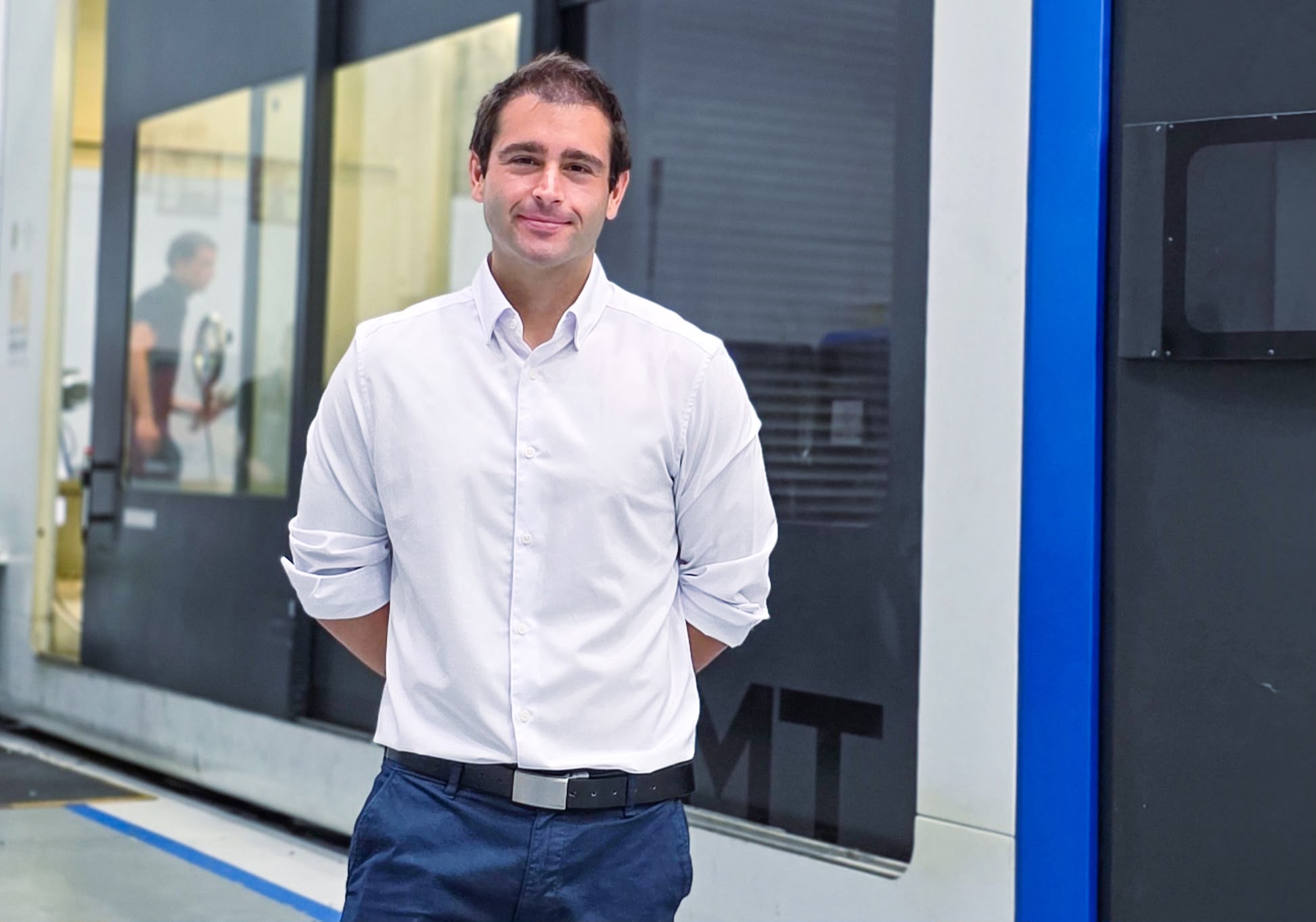
Active vibration control in large scale machine tools
This keynote examines the evolution of active vibration control from a research concept into
a transformative industrial technology for advanced manufacturing. Drawing on nearly two decades of
developments, the presentation explores how the integration of advanced actuators, sensors and
control algorithms is redefining the dynamic performance limits of large-scale machine tools.
Particular attention is given to the suppression of chatter vibrations, one of the most persistent barriers
to productivity, process stability, and surface quality, through active damping solutions successfully
deployed in large machine tools, grinding systems, robotic machining platforms and boring
applications. Beyond chatter mitigation, the presentation highlights emerging strategies that exploit
feed-drive control, virtual vibration absorbers and feedforward compensation to improve accuracy,
reduce forced vibrations and enable more aggressive machining conditions without compromising part
quality. Combining fundamental insights in structural dynamics, control engineering and machine
design with proven industrial implementations, the presentation demonstrates how active vibration
control is becoming a key enabling technology for the next generation of high-performance
manufacturing systems and outlines future opportunities for smarter, faster and more precise
production environments.
Dr. Oier Franco is a researcher specializing in machine tool dynamics, precision
mechatronics and control engineering for advanced manufacturing systems. His work addresses the
challenges of improving machining performance through the integration of structural dynamics, feed
drive control and vibration mitigation technologies. Over the course of his career, he has contributed to
numerous European and industrial research initiatives, advancing the development of high
performance machine tools and intelligent manufacturing solutions. His expertise spans machine tool
dynamics, motion control and mechatronic system design, with a particular emphasis on translating
scientific research into industrial innovation. Through his work, he has supported the development of
next-generation manufacturing platforms capable of achieving higher levels of precision, productivity
and process stability.
.
.
Exhibitors
.